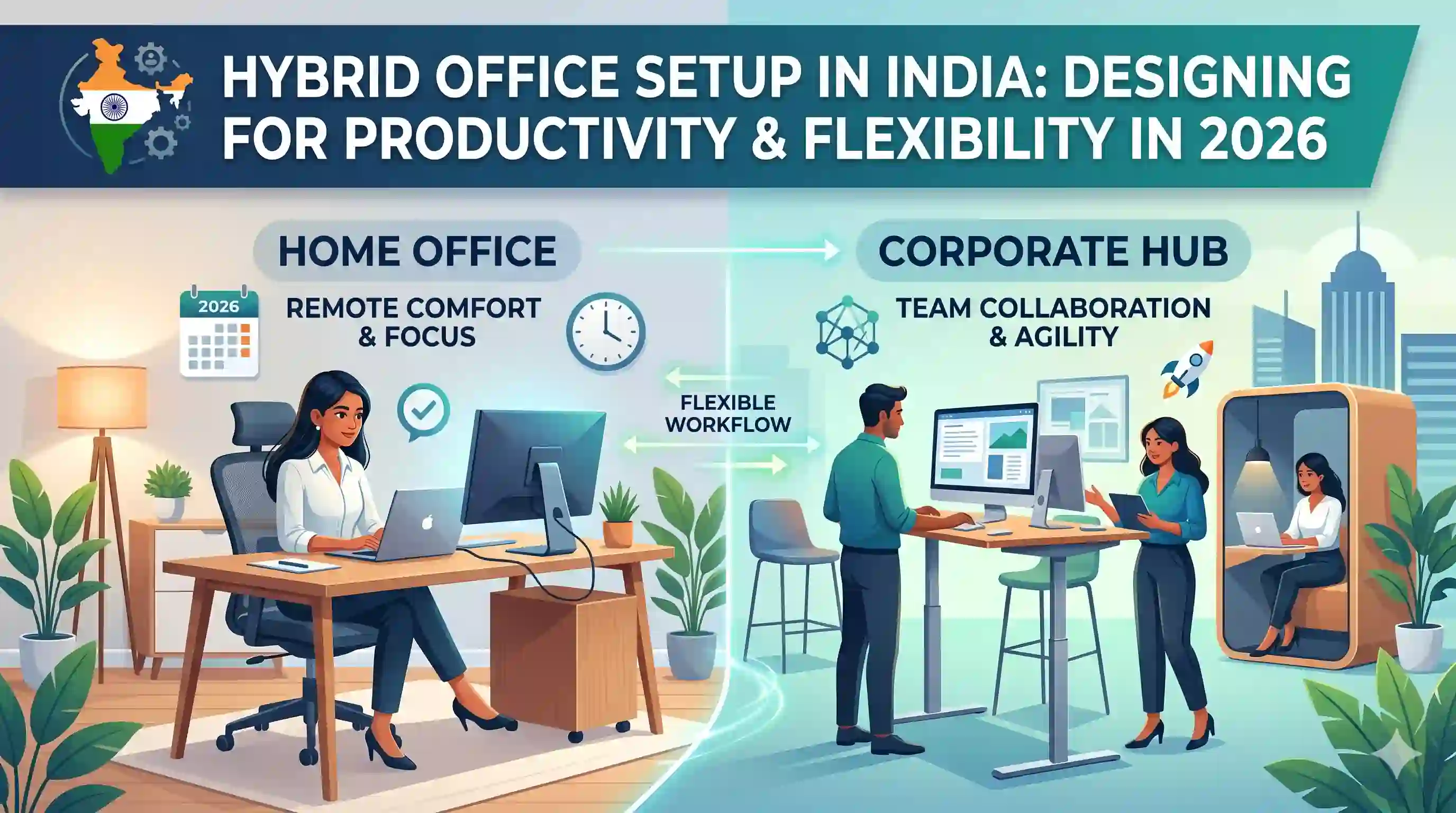
Hybrid Office Setup in India: How to Design a Workspace for Productivity and Flexibility in 2026
The Way India Works Has Changed Permanently
Over the past few years, the Indian corporate landscape has undergone a shift that no return-to-office mandate can fully undo. Employees have experienced the flexibility of working from home, and businesses have seen that productivity does not require everyone to be present in the same room every day. What has emerged from this is a new working model that most companies are now building around: the hybrid office.
According to multiple workforce surveys conducted across Indian metros, more than 60 percent of mid-to-large companies now operate on some form of hybrid schedule. Cities like Pune, Bengaluru, Mumbai, and Hyderabad are seeing significant demand for office redesigns as businesses reconfigure their spaces to serve a workforce that comes in on rotation rather than all at once.
The problem is that most offices were not designed for this. Fixed workstations assigned to individual employees, rigid meeting room layouts, and rows of identical desks make very little sense when half your team is remote on any given day. The traditional office setup, built around full occupancy and individual ownership of space, actively works against the flexibility that hybrid work demands.
This guide is written for office owners, HR managers, facility heads, and business decision-makers who want to design a workspace that genuinely supports how their teams work today.
What Exactly Is a Hybrid Office Setup?
A hybrid office is a workspace designed to accommodate both in-office and remote workers simultaneously and interchangeably. Rather than assigning permanent desks to every employee, it uses shared workstations, flexible seating, collaborative zones, and quiet focus areas in a layout that adjusts to daily occupancy patterns.
The key features of a well-designed hybrid office setup include:
Unassigned or hot-desking workstations that any employee can use on the days they come in. Collaborative zones where teams can gather for discussions, brainstorming, or video calls. Quiet zones that provide distraction-free environments for deep, focused work. Technology infrastructure that supports seamless connectivity between in-office and remote employees. Modular furniture that can be reconfigured as team sizes and work patterns evolve.
For businesses, the benefits are real and measurable. Real estate costs come down significantly when space is optimised for actual usage rather than theoretical full occupancy. For employees, a well-designed hybrid office feels intentional rather than improvised, which directly affects morale, focus, and the quality of in-person collaboration.
The Core Elements of a Functional Hybrid Workspace
Flexible Workstations
Hot-desking works well when the workstations are genuinely comfortable and easy to personalise quickly. Height-adjustable desks allow employees of different builds to set up correctly in minutes. Sufficient surface area, good cable management, and easy access to power and data points are non-negotiable basics. When workstations are well-designed, employees do not feel penalised for not having a permanent desk.
Explore our range of height-adjustable desks and modular workstations
Ergonomic Seating
In a hot-desking environment, ergonomic chairs matter more, not less. Employees are sitting in different chairs each day, and if those chairs do not support proper posture, the physical toll accumulates quickly. Adjustable lumbar support, seat height, armrest positioning, and backrest angle are features that every chair in a shared office should offer. Cutting costs on seating is one of the most counterproductive decisions a business can make.
Browse our ergonomic office chairs designed for all-day comfort
Collaborative Spaces
Hybrid teams come into the office specifically to collaborate. If your meeting rooms are always booked and your open areas are too noisy for conversation, people stop seeing a reason to make the commute. Well-designed collaborative spaces include both formal meeting rooms for structured discussions and informal breakout zones with comfortable seating for quick catch-ups and creative sessions. Acoustic considerations, good lighting, and easy access to display screens matter a great deal here.
Quiet Zones for Focused Work
Not every task benefits from an open, buzzing environment. Many employees come to the office to work on reports, presentations, or detailed analysis that requires sustained concentration. A hybrid office needs dedicated quiet zones where conversation is limited and distractions are minimised. These can be small enclosed booths, partitioned desk clusters, or designated sections of the floor. The key is that the boundaries are respected and the furniture supports focused individual work.
Why Ergonomics Cannot Be an Afterthought
Ergonomics in a hybrid office is not simply about comfort. It is a business issue. Poor workstation ergonomics leads to musculoskeletal complaints, increased sick days, reduced concentration, and lower output over time. In India, where awareness of workplace ergonomics is still developing, many companies are losing productivity daily without connecting the cause to their furniture choices.
A proper ergonomic office design considers desk height relative to monitor position, chair adjustability relative to the user's body proportions, keyboard and mouse placement to avoid wrist strain, and adequate lighting to reduce eye fatigue. When employees sit correctly at properly set up workstations, they focus better and tire less quickly. The investment in ergonomic furniture pays back in measurable productivity gains.
Read our guide on setting up an ergonomic workstation
Smart Space Planning for Indian Offices
Office space in Indian cities, particularly in Pune, Mumbai, and Bengaluru, is expensive. Hybrid work creates an opportunity to use that space more intelligently rather than simply fitting in more desks.
Start by analysing actual attendance patterns. If your team comes in on a rotating basis and average daily occupancy sits around 60 percent, you do not need a workstation for every employee. Designing for 70 to 75 percent capacity with flexible overflow options gives you efficiency without creating a cramped experience on high-attendance days.
Modular furniture is central to intelligent space planning. Modular workstations can be reconfigured as team sizes change. Storage units that double as room dividers create zoning without permanent walls. Foldable or stackable furniture in meeting and training areas allows the same space to serve multiple purposes across the week.
For smaller offices, vertical storage solutions and compact ergonomic furniture free up floor space considerably while maintaining a functional and professional environment.
Technology Integration in a Modern Hybrid Office
A hybrid office without the right technology infrastructure will frustrate everyone, both those in the office and those joining remotely. The furniture and the technology need to work together.
Smart desks with built-in charging pads and integrated cable management keep workstations clean and functional. Booking systems for desks and meeting rooms prevent the daily scramble for space. Meeting rooms need high-quality cameras, microphones, and display screens positioned correctly so that remote participants are not an afterthought in every discussion.
Cable management deserves particular attention in shared spaces. Exposed cables across hot-desking areas create clutter and hazard. Desks with built-in cable channels and centralised power access points make a significant difference to both the appearance and functionality of the workspace.
Mistakes That Undermine Hybrid Office Design
Overcrowding the layout. Fitting in as many workstations as possible defeats the purpose of hybrid design. Space to move, breathe, and choose where to work is part of what makes the hybrid model attractive to employees.
Ignoring employee input. HR managers who design spaces without consulting the people who will use them often end up with layouts that look good on a floor plan but do not work in practice. Brief surveys or workshops before a redesign save considerable time and money.
Treating all areas the same. A single open-plan floor with identical furniture does not serve a hybrid team. Different work modes need different environments. A workspace that does not differentiate between collaboration and focus time creates constant conflict between the two.
Buying furniture on price alone. Low-cost chairs and desks that wear out within two years, provide no ergonomic support, and look unprofessional send a message to employees about how much the business values their experience. Quality office furniture is a capital investment, not a recurring expense.
The Cost vs ROI Argument for Quality Office Furniture
Many businesses hesitate to invest in quality office furniture because the upfront cost is visible and the return is not immediately obvious. But the numbers do support the investment.
A well-designed ergonomic office setup reduces absenteeism related to physical discomfort. It reduces turnover, since employees who feel their workplace is invested in their wellbeing are less likely to leave. It increases the quality of in-person collaboration on the days people choose to come in. And quality furniture lasts significantly longer, meaning the cost spread over five to eight years is far more reasonable than the sticker price suggests.
For businesses operating a hybrid office setup in India, the design of the workspace directly influences whether employees see value in coming in at all. If the office is not meaningfully better than working from home, attendance will remain low regardless of policy.
Build a Workspace That Works for Your Team
The hybrid model is not a temporary adjustment. It is the structure around which the Indian corporate workplace is reorganising itself for the long term. Offices that are designed thoughtfully for this model will attract better talent, retain existing employees more effectively, and produce better outcomes from the days when teams are together.
Getting the design right requires more than buying new furniture. It requires understanding how your specific team works, what mix of collaboration and focus time your roles demand, and how your space can flex as those needs change.
Our team specialises in designing and furnishing hybrid office spaces across Pune and India. Whether you are redesigning an existing office or setting up a new one, we will work with your floor plan, budget, and workforce structure to create a workspace that supports productivity from day one.
[Book a Free Office Design Consultation]
Frequently Asked Questions
What is the ideal furniture setup for a hybrid office in India?
A good hybrid office combines height-adjustable workstations, ergonomic chairs with full adjustability, modular storage, and clearly defined zones for collaboration and focused work. The furniture should be flexible enough to reconfigure as team size and attendance patterns shift over time.
How much space should I plan per person in a hybrid office setup?
A general planning benchmark for hybrid offices is between 60 and 80 square feet per workstation, accounting for circulation space. Since not all employees are present simultaneously, you can design for 65 to 75 percent of your total headcount and supplement with breakout and lounge seating for overflow.
Is ergonomic office furniture worth the cost for small businesses?
Yes, particularly for small businesses where each employee's output matters more. Ergonomic chairs and desks reduce fatigue and physical discomfort, which directly affects focus and daily productivity. The long-term cost of poor seating, in terms of sick days and staff turnover, typically exceeds the cost of buying quality furniture upfront.
What are the best office furniture options for hybrid offices in Pune?
Look for modular workstations that allow reconfiguration, multi-adjustable ergonomic chairs, and collaborative furniture that serves both formal and informal settings. Local suppliers with customisation options are preferable since standard imported sizes often do not suit Indian office dimensions or usage patterns.
How do I plan a hybrid office layout without wasting space?
Start by tracking actual attendance over four to six weeks to understand your real occupancy pattern. Design workstation capacity around your average daily count rather than total headcount. Use modular furniture to create zones that serve multiple purposes, and keep at least 30 percent of your floor plan as open, flexible space that can adapt to different needs across the week.