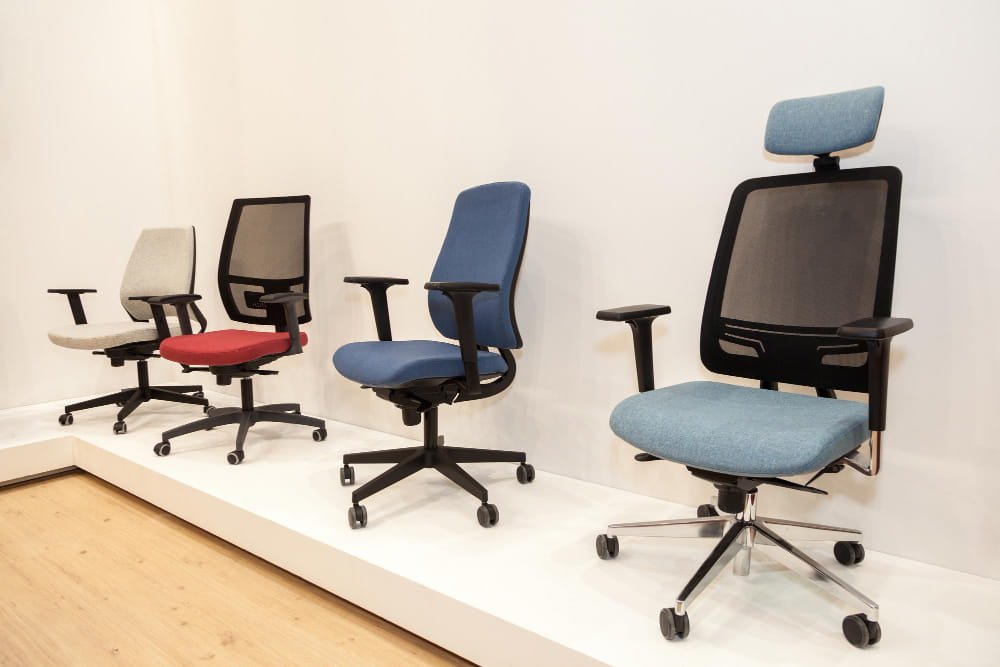
Standard Size of Office Chair in India – A Complete Dimensions Guide | Office Mantra
If you have ever bought an office chair and realised it was too low for your desk, too wide for your workstation, or simply uncomfortable after two hours of sitting — you are not alone. Most people buy office chairs based on looks or price alone, completely ignoring the one thing that matters most: size.
The standard size of an office chair is not just a number on a spec sheet. It directly determines whether your employees sit comfortably for an 8-hour workday or end up with back pain, poor posture, and reduced productivity. Getting the dimensions right is one of the most important — and most overlooked — aspects of office design.
In this complete guide, we break down every dimension you need to understand before buying an office chair in India — from seat height and width to backrest, armrest, and overall footprint.
Quick Answer — What Is the Standard Size of an Office Chair? A standard office chair in India typically has a seat height of 17–21 inches (43–53 cm), seat width of 17–20 inches (43–51 cm), seat depth of 15–17 inches (38–43 cm), and a backrest height of 18–22 inches (46–56 cm). These dimensions suit most Indian adults for general office use. |
Why Chair Size Matters More Than You Think
A chair that is the wrong size does far more damage than just causing discomfort. Research by the National Institute for Occupational Safety and Health (NIOSH) shows that poorly fitted seating is one of the leading causes of musculoskeletal disorders among office workers — including lower back pain, neck strain, and repetitive stress injuries.
In India, where most office employees sit for 7–9 hours a day, choosing the right chair size is a workplace health decision, not just a furniture one. Here is what happens when chair dimensions are off:
- Seat too high: feet dangle, cutting off circulation to the legs
- Seat too low: knees rise above hips, straining the lower back
- Seat too deep: edge of seat presses behind knees, causing discomfort
- Seat too shallow: thighs do not get enough support, causing fatigue faster
- Backrest too short: lumbar spine goes unsupported, causing slouching
- Armrests too high or too wide: shoulders hunch or arms float awkwardly
Did You Know? According to a workplace wellness survey across Indian IT companies, over 60% of employees reported back or neck discomfort — and incorrect chair sizing was among the top three contributing factors cited by occupational health professionals. |
Complete Standard Office Chair Dimensions Chart
Here is a comprehensive reference chart covering all key dimensions of a standard office chair in India:
| Dimension | Standard Range (cm) | Standard Range (inches) | Ideal For |
|---|---|---|---|
| Seat Height (adjustable) | 43 – 53 cm | 17 – 21 inches | Most Indian adults (5'2" to 6'0") |
| Seat Width | 43 – 51 cm | 17 – 20 inches | Standard body frame |
| Seat Depth | 38 – 43 cm | 15 – 17 inches | Proper thigh support |
| Backrest Height | 46 – 56 cm | 18 – 22 inches | Mid-back to shoulder blade support |
| Backrest Width | 35 – 48 cm | 14 – 19 inches | Covers lumbar and upper back |
| Armrest Height (from seat) | 20 – 25 cm | 8 – 10 inches | 90-degree elbow position |
| Armrest Width (gap) | 46 – 51 cm | 18 – 20 inches | Clears hips on both sides |
| Overall Chair Height | 91 – 127 cm | 36 – 50 inches | Including backrest, fully raised |
| Base Diameter (footprint) | 61 – 71 cm | 24 – 28 inches | Stable 5-star base |
| Weight Capacity | 90 – 120 kg | 200 – 265 lbs | Standard to heavy-duty |
Office Mantra Tip When buying chairs for an Indian office, prioritise models with seat height adjustable between 43–53 cm. This range comfortably accommodates the most common adult height range in India (157 cm to 182 cm) when paired with a standard desk height of 73–76 cm. |
Understanding Each Chair Dimension in Detail
1. Seat Height — The Most Important Measurement
Seat height is the distance from the floor to the top of the seat cushion. This is the single most critical dimension in an office chair. When set correctly, your feet should rest flat on the floor, your thighs should be parallel to the ground, and your knees should form a 90-degree angle.
Standard range in India: 43 cm to 53 cm (adjustable). Most quality office chairs come with a pneumatic gas lift that lets users adjust height within this range. If your employees are predominantly shorter (below 5'4"), look for chairs that go down to 40–42 cm. For taller employees (above 6'0"), opt for chairs with a high range up to 55–58 cm.
2. Seat Width — Room to Sit Comfortably
Seat width is the horizontal measurement across the seat from one side to the other. Standard office chairs in India measure 43–51 cm wide. This should be at least 2–3 cm wider than the user's hip width on each side to allow natural movement without feeling squeezed.
For general staff workstations, 45–48 cm is the sweet spot. For premium executive chairs, wider seats of 50–54 cm are common and provide a more generous, comfortable feel.
3. Seat Depth — Supporting the Full Thigh
Seat depth is the front-to-back measurement of the seat cushion. The ideal depth allows you to sit with your back against the lumbar support while leaving 2–4 fingers of space between the back of your knees and the front edge of the seat.
Too shallow and your thighs are unsupported. Too deep and the edge digs behind your knees. Standard range: 38–43 cm. Some ergonomic chairs offer adjustable seat depth — a valuable feature for teams with varied body types.
4. Backrest Height — Protecting the Spine
The backrest height determines how much of your spine is supported. There are three categories:
- Low-back chairs (backrest 30–43 cm): support only the lumbar region — suited for short-duration tasks
- Mid-back chairs (backrest 43–56 cm): support lumbar and mid-back — the most common office choice in India
- High-back / executive chairs (backrest 56–70 cm+): support the entire spine including upper back and neck — ideal for long work sessions and senior roles
For employees working 6+ hours daily, mid-back or high-back chairs are strongly recommended.
5. Armrest Height and Width
Armrests should allow your elbows to rest at a 90-degree angle without your shoulders hunching up or drooping down. Standard armrest height from the seat surface is 20–25 cm. The gap between armrests (inner width) should be at least 46 cm to comfortably clear the hips.
Many modern ergonomic chairs offer 3D or 4D adjustable armrests — these allow height, angle, width, and pivot adjustments, making them suitable for virtually any user and highly recommended for intensive desk work.
6. Base Diameter — Stability and Mobility
A standard office chair base (the star-shaped bottom with castors) measures 61–71 cm in diameter. A wider base provides more stability and is particularly important for heavier chairs or users. Five-star bases are the industry standard — they distribute weight evenly and reduce tip-over risk significantly compared to four-star bases.
Standard Chair Sizes by Chair Type — A Quick Reference
Different types of office chairs have different standard size ranges. Here is a type-wise breakdown:
| Chair Type | Seat Height | Backrest Height | Best For |
|---|---|---|---|
| Task / Staff Chair | 43 – 52 cm | 40 – 50 cm | General office staff, IT employees |
| Executive Chair | 46 – 55 cm | 56 – 72 cm | Managers, directors, senior staff |
| Ergonomic Chair | 40 – 55 cm (adjustable) | 48 – 65 cm | Long hours, health-focused workplaces |
| Visitor / Guest Chair | 44 – 47 cm (fixed) | 38 – 45 cm | Reception areas, meeting rooms |
| Conference Chair | 44 – 48 cm | 45 – 55 cm | Boardrooms, conference halls |
| Training / Stackable Chair | 43 – 46 cm (fixed) | 35 – 42 cm | Training rooms, seminar halls |
| Cafeteria / Canteen Chair | 43 – 46 cm (fixed) | 35 – 45 cm | Break rooms, cafeterias |
How to Choose the Right Chair Size for Your Team
Different employees have different needs. Here is a practical framework for matching chair size to your team:
Step 1 — Know Your Desk Height
Standard office desks in India are 73–76 cm high. Your chair seat height should let users sit with their forearms parallel to the desk surface. If your desks are at a non-standard height, choose chairs with a wider adjustment range.
Step 2 — Consider Employee Height Range
If your team has a wide range of heights, choose chairs with the broadest adjustment range possible — ideally 43 to 55 cm. For teams that are predominantly shorter (common in many Indian offices), bias towards chairs that go lower rather than higher.
Step 3 — Match Chair Type to Role Duration
Employees who sit for less than 4 hours a day can manage with standard task chairs. Employees who sit for 6–9 hours daily — such as developers, data analysts, or customer support staff — should be given ergonomic or high-back executive chairs. The cost difference is justified by reduced sick days and improved output.
Step 4 — Account for Weight Capacity
Standard chairs support up to 100–110 kg. If you have employees above this range, invest in heavy-duty chairs rated for 120–150 kg. Using an undersized chair is both a health risk and a liability.
Step 5 — Check the Space Available
The base diameter (61–71 cm) determines how much floor space each chair occupies. In tight workstations, opt for chairs with a smaller base. Also ensure there is at least 60–90 cm of clear space behind the desk for the chair to roll back comfortably.
Quick Sizing Rule of Thumb A good fit: seat height = lower leg length + 2.5 cm | Seat depth = thigh length minus 5 cm | Backrest height = at minimum, reaches the bottom of the shoulder blades. If in doubt, choose a chair with the widest adjustment range — adaptability beats a fixed 'average' every time. |
Standard vs Ergonomic Chair — Does Size Differ?
Standard task chairs follow the dimension ranges we have outlined above — fixed or minimally adjustable. Ergonomic chairs use the same base dimension ranges but offer far more adjustability within those ranges:
- Adjustable lumbar support (moves up/down within the backrest)
- Adjustable seat depth (slides the seat pan forward/backward)
- Adjustable armrest height, width, and pivot (3D/4D armrests)
- Headrest (extends the backrest height beyond standard)
- Tilt tension and tilt lock for personalised recline
The key difference is not the overall size — it is the degree of customisation within that size. An ergonomic chair lets each employee fine-tune it to their body, whereas a standard chair provides one or two fixed positions. For an office of 20 or more employees with varied body types, ergonomic chairs are worth the investment.
Office Chair Sizing for Indian Body Types — What to Keep in Mind
International chair standards are often designed around Western body dimensions, which skew taller and broader than the average Indian adult. Here is what to keep in mind when buying for an Indian workforce:
- Average Indian adult height: 164–166 cm (men), 152–154 cm (women) — chairs should comfortably go down to 43 cm seat height
- Seat depth: Indian adults with shorter torsos often find standard deep seats uncomfortable — look for 38–40 cm depth or adjustable depth
- Seat width: standard 45–48 cm works well for most — wider is not always better for smaller frames
- Lumbar position: position lumbar support at 23–27 cm from the seat surface to correctly support the inward curve of an average Indian adult's lower back
Office Chair Size vs Price — What Can You Expect in India?
Here is a realistic pricing guide based on chair type and size category for the Indian market in 2025:
| Chair Category | Key Size Feature | Price Range (per chair) | Best For |
|---|---|---|---|
| Basic Task Chair | Fixed height ~45 cm | ₹3,000 – ₹6,000 | Training rooms, cafeterias |
| Mid-back Staff Chair | Adjustable 43–52 cm | ₹5,000 – ₹10,000 | General office staff |
| High-back Executive Chair | Adjustable 46–55 cm, tall backrest | ₹9,000 – ₹22,000 | Managers, senior staff |
| Ergonomic Chair | Full adjustment range | ₹12,000 – ₹35,000 | Long-hours, IT/tech teams |
| Visitor / Conference Chair | Fixed 44–47 cm | ₹3,500 – ₹9,000 | Meeting rooms, reception |
Why Office Mantra for Office Chairs in Pune?
At Office Mantra, we do not just sell chairs — we help you choose the right chair for each role, room, and body type in your office. Here is why over 1,000 businesses across Pune and India trust us:
- Wide range from basic task chairs to premium ergonomic and executive models
- All chairs tested to Indian usage standards — weight capacity, durability, and adjustment range
- Customisation available — fabric colour, armrest type, base finish, headrest options
- Direct manufacturer pricing — no middleman markup
- Bulk order discounts for offices of 10 chairs and above
- ISO 9001:2015 certified manufacturing — consistent quality, batch after batch
- After-sales support including repair and replacement of pneumatic cylinders, castors, and armrests
Frequently Asked Questions
Q1. What is the standard seat height for an office chair in India?
The standard seat height range for an office chair in India is 43 cm to 53 cm (17 to 21 inches). This adjustable range suits most Indian adults when paired with a standard desk height of 73–76 cm. For employees who are shorter, look for chairs that adjust down to 40–42 cm.
Q2. What is a good seat depth for an office chair?
A good seat depth for an office chair is 38 to 43 cm (15 to 17 inches). When seated correctly, there should be a 2–4 finger gap between the back of your knee and the front edge of the seat. Anything deeper creates pressure behind the knees; anything shallower fails to support the full thigh.
Q3. What is the difference between a mid-back and high-back office chair?
A mid-back chair has a backrest height of 43–56 cm and supports the lumbar and mid-back region. A high-back or executive chair has a backrest of 56–72 cm and supports the entire spine including the upper back and neck. High-back chairs are recommended for employees who sit for more than 6 hours daily.
Q4. How much space does an office chair take up?
A standard office chair base has a diameter of 61–71 cm. You should allow at least 90 cm of clear space behind the desk for the chair to roll back comfortably. In tighter workstations, chairs with a 61 cm base and compact castors work best.
Q5. Can one chair size fit all employees?
Not ideally. For the best results, chairs should be matched to the user's height and build. However, a chair with a wide adjustment range (seat height 43–55 cm, adjustable depth, and 3D armrests) can accommodate a broad range of body types. For mixed teams, ergonomic chairs with maximum adjustability are the safest choice.
Q6. What weight capacity should I look for in an office chair?
Standard office chairs are rated for 90–110 kg. For heavier users or environments where chairs see intensive use, choose heavy-duty models rated at 120–150 kg. Always check the manufacturer's weight rating before purchasing — exceeding it significantly shortens the chair's lifespan and creates safety risks.
Final Thoughts
Choosing the right office chair size is not complicated — but it does require knowing what to look for. The standard dimensions we have covered here give you a reliable baseline. From there, match the chair type to the role, adjust for your team's height range, and prioritise adjustability for employees who sit for long hours.
A correctly sized chair is one of the best investments you can make in your team's health and productivity. The cost of a good chair is always less than the cost of lost productivity, physiotherapy bills, or high employee turnover driven by an uncomfortable workplace.
Need Help Choosing the Right Chair for Your Office? Office Mantra offers a free consultation to help you select the right chair type, size, and quantity for your office — whether you are setting up 5 workstations or 500. Visit our showroom at Balewadi or Chakan in Pune, call +91 77982 03669, or enquire online at officemantra.in. |