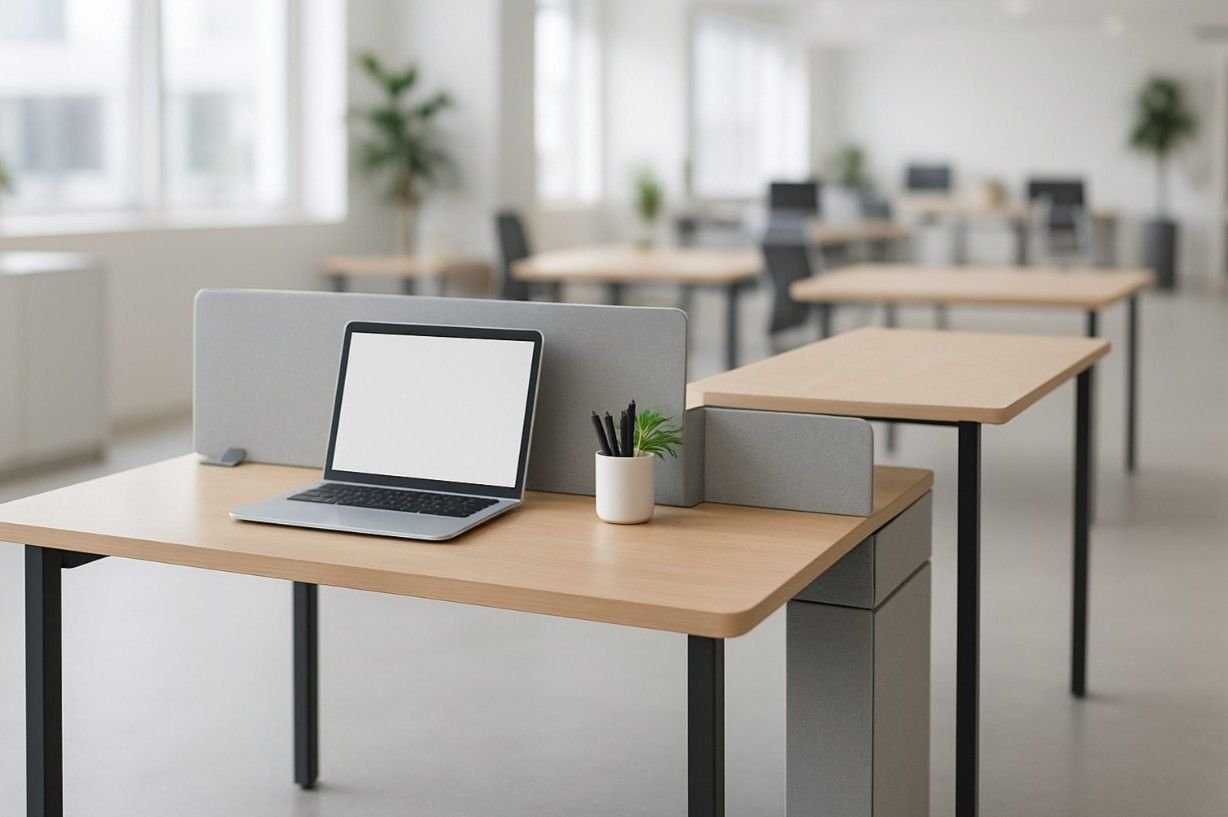
Affordable Modular Office Desks for Startups: 2025 Guide
Modular office desks are flexible, pre-fabricated workstation systems designed with interchangeable parts like legs, screens, and tops that allow businesses to expand, reconfigure, or relocate their office layout quickly without the high costs of traditional construction.
Starting a business is expensive. Between hiring talent, buying software licenses, and marketing your product, your burn rate is frequently on your mind. So, when it comes to furnishing your new office, the temptation to cut corners is huge. You might think, "Let's just get a local carpenter to nail some plywood to the wall," or "Let's buy the cheapest tables we can find online."
At Office Mantra, we believe your workspace should be an asset, not a liability. In 2025, the smart move for lean startups isn't just "buying desks"—it's investing in modular office desks that grow as you grow. This guide is written for the founder who wants to spend wisely, look professional, and scale fast.
Why "Fixed" Furniture Fails Growing Startups
Most first-time founders make the mistake of viewing office furniture as a static purchase. You buy a desk, you put it in a corner, and you forget it. But a startup is a living organism. You might have 5 employees today, 12 next month, and 50 by next year.
If you choose traditional carpenter-made tables, you are stuck. You cannot move them without breaking them. You cannot expand them without a mess of sawdust and glue.
The Scalability Trap
Most experts agree that adaptability is the single most significant factor in physical workspace design for 2025. If your furniture can't change, your office becomes a bottleneck. Modular systems solve this. They are like building blocks for your office. Need to add two new developers? Just unbolt the end leg, add a new module, and lock it in. No dust, no noise, no downtime.
This One Feature Will Save You 15% on Rent
Real estate in hubs like Baner or Hinjewadi is pricey. Traditional desks often waste space with bulky legs and inefficient depths. Modular office tables are designed for density. By using shared legs (where two desks share one support structure) and optimized depths (typically 600mm for laptops), you can fit 20% more people into the same room comfortably. That is not just furniture savings; that is rent savings.
Modular vs. Carpenter-Made: The Real Cost Breakdown
Let’s look at the numbers. A study implies that while modular options might seem pricier upfront, the long-term savings are undeniable.
Table 1: The 5-Year Cost Comparison
| Feature | Modular Office Desks | Carpenter-Made / Fixed Desks |
| Setup Time | 2–4 Days (Factory made & assembled on-site) | 3–4 Weeks (Noisy on-site work) |
| Finish Quality | Machine-pressed laminates (Bubble-free) | Hand-pasted (Prone to peeling) |
| Resale Value | High (Can be disassembled and sold) | Zero (Usually scrapped as debris) |
| Wire Management | Hidden metal raceways included | Messy wires hanging loose |
| Scalability | Easy (Add/Remove modules) | Impossible (Must destroy to change) |
3 Layout Strategies for High-Performance Teams
Not all desks do the same job. Depending on whether your team reports code, makes sales calls, or designs graphics, you need different setups.
1. The Linear Workstation (The Space Saver)
This is the classic "call center" or "coding row" style. Desks are arranged in straight lines, often facing each other.
- Best for: Tech teams, data entry, and maximizing headcount.
- Why it works: It uses the least amount of floor space per person. You can easily integrate office chairs and storage pedestals without cluttering the aisle.
2. The 120-Degree Pod (The Collaborator)
This layout uses dog-bone or honeycomb-shaped desks. Users sit at a 120-degree angle to each other.
- Best for: Creative agencies, marketing teams, and collaborative groups.
- Why it works: It puts everyone within eye contact but not directly staring at each other’s screens. A 2024 report indicates that these layouts can save up to 15-25% of space compared to bulky cubicles while improving team communication.
3. Hot Desking & Hybrid Zones
With hybrid work becoming the norm, you don't need a desk for 100% of your staff if only 60% show up daily.
- Best for: Sales teams and consultants.
- Why it works: Install a few "landing zones" or high tables. This allows you to buy fewer desks but higher quality ones.
Ergonomics: Why Your Back (and Budget) Will Thank You
In the rush to save money, don't buy cheap chairs. Office chairs are the most critical tool for your employee's health. A bad chair leads to back pain, which leads to sick days, which kills productivity.
According to a 2025 industry projection, the Indian market is shifting heavily towards wellness-focused furniture. You don't need a ₹50,000 chair, but you do need:
- Lumbar Support: Essential for long coding sessions.
- Mesh Backs: Critical for airflow in Indian weather.
- Adjustable Height: Because one size does not fit all.
Don't Forget the Home Team
If you have remote workers, consider offering a stipend for desks for home offices. A simple, compact modular table at home ensures your remote staff is as productive as your in-office team. It sends a strong message that you care about their work environment, wherever it is.
Material Science 101: PLPB vs. MDF
When you look at quotes, you'll see terms like "PLPB" and "MDF." Here is the simple version:
- PLPB (Pre-Laminated Particle Board): The industry standard for workstations. It holds screws well (great for re-assembling) and is cost-effective.
- MDF (Medium Density Fiberboard): Smoother and denser, but heavier and often more expensive. It doesn't hold screws as well if you disassemble it multiple times.
Our advice: For general workstations, stick to 25mm PLPB with PVC edge banding. It offers the best balance of durability and price for startups.
Checklist: Questions to Ask Your Furniture Supplier
Before you sign that purchase order, ask these questions to ensure you aren't getting a bad deal:
- "Is this factory-direct or are you a trader?" (Buying direct from a manufacturer like Office Mantra saves you the dealer margin).
- "Can I buy just one more seat later?" (Ensure they stock the series so you can match it in 6 months).
- "What is the thickness of the metal legs?" (Avoid anything less than 1.6mm gauge; it will wobble).
- "Is wire management included?" (Retrofitting cable trays later is a nightmare).
- "Do you offer buy-back?" (Some manufacturers will buy back old structures when you upgrade).
Freshness Update: Pricing Trends for Q1 2025
Check back here every quarter! As of early 2025, raw material costs for steel and engineered wood have stabilized. However, labor costs in metro cities are rising. Locking in your furniture order now, before the fiscal year-end rush in March, can save you approximately 5-8%.
Conclusion: Which Setup is Best for You in 2025?
There is no single "perfect" desk. The best desk is the one that fits your budget today but doesn't limit your growth tomorrow.
If you are a bootstrap startup with 5 people, start with a simple linear modular setup. It’s the most affordable and space-efficient option. As you grow, you can add premium cabins or collaborative pods.
At Office Mantra, we don't just sell furniture; we build the infrastructure for your growth. We understand the hustle because we manufacture right here in Pune, supporting businesses just like yours.
Ready to stop working off folding tables? or visit our Branch Pune experience center to see how affordable quality can be.
Frequently Asked Questions (FAQ)
1. What exactly is "modular" office furniture?
Think of modular furniture like a building set for adults. Instead of a solid, heavy piece of wood that is nailed together, modular furniture is made of separate components—like metal legs, table tops, screens, and brackets—that are engineered to fit together perfectly. The most significant advantage is that you can assemble, disassemble, and rearrange these parts to create different layouts as your team needs change, without destroying the furniture.
2. Is modular furniture really cheaper than hiring a local carpenter?
If you look only at the initial price tag, a carpenter might quote a slightly lower number. However, carpenter-made furniture is a "sunk cost"—once it is built, you can't move it or change it without breaking it. Modular furniture is an investment; it is durable, has a high resale value, and saves you money in the long run because you don't have to buy new desks every time you move or expand.
3. Which material is best for office desks: PLPB, MDF, or Plywood?
For general office workstations, Pre-Laminated Particle Board (PLPB) is the industry champion. It is cost-effective, holds screws tightly (which is vital for modular parts that might need re-assembling), and resists warping. While MDF is smoother, it is heavier and doesn't hold screws as well over time. Plywood is strong but significantly more expensive and often overkill for standard desks.
4. How much space can I save with a modular layout?
You can save a surprising amount of floor space. Modular "linear" workstations often share legs and screens, which eliminates the dead space between separate tables. Reports indicate that switching to an optimized modular layout can increase your usable space by up to 30%, allowing you to fit more people comfortably into the same office.
5. How long does it take to install modular desks?
Speed is a huge benefit here. Since the parts are pre-manufactured in a factory, on-site assembly is speedy. A typical startup office setup can often be installed in just 2 to 4 days. Compare that to carpentry, which can take 3 to 6 weeks of noisy, dusty work inside your office.
6. Can I add more desks later if my team grows?
Absolutely. This is the main "growth hack" feature of modular systems. If you start with a row of 4 desks and hire 2 more people, you simply order an "add-on" module. The installer will unbolt the end leg, attach the new desk parts, and put the leg back on. It creates a seamless row without mismatched furniture.
7. What is the standard height for an office desk in India?
The standard ergonomic height for a fixed office desk is typically between 73 cm and 75 cm (approx. 29–30 inches). This height is designed to be comfortable for the majority of the workforce when paired with an adjustable office chair.