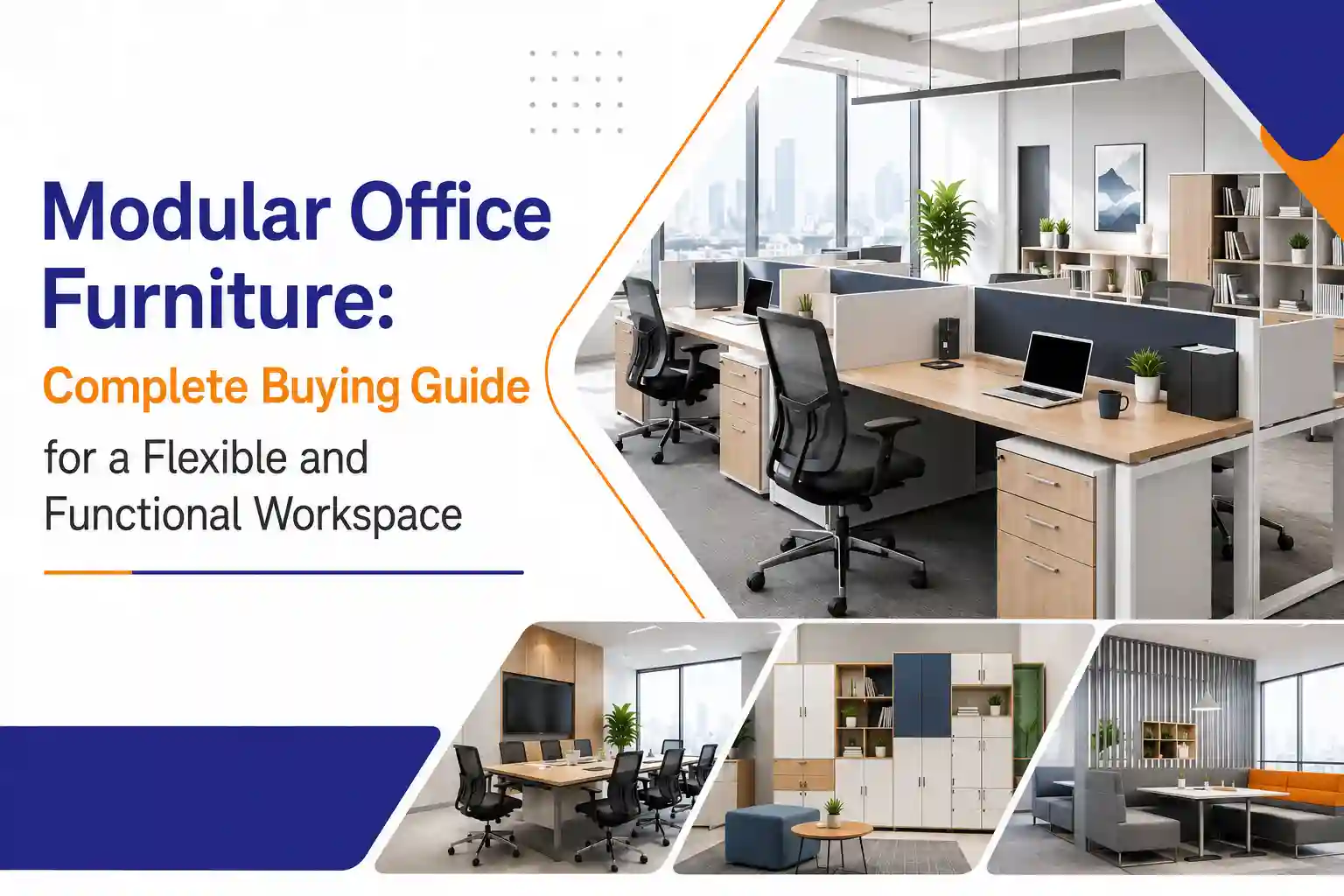
Modular Office Furniture: Complete Buying Guide for a Flexible and Functional Workspace
Office furniture is not simply a collection of desks, chairs, and storage cabinets. It determines how employees move, communicate, concentrate, organise their work, and use the available space.
This is why more businesses are choosing modular office furniture instead of fixed furniture systems. Modular solutions allow companies to build workspaces using coordinated components that can be configured, expanded, relocated, or modified as requirements change.
However, not every modular system offers the same quality, flexibility, or long-term value. Before selecting a product, manufacturer, or modular office furniture supplier, businesses must assess their floor plan, employee requirements, materials, technology needs, future expansion, installation support, and budget.
This guide explains how modular office furniture works, the available product types, its benefits, the factors affecting cost, and how to select the right supplier for your office project.
What Is Modular Office Furniture?
Modular office furniture is a component-based furniture system designed using individual units that work together. These units can be assembled in different configurations to create workstations, desks, meeting areas, storage systems, reception counters, executive cabins, and collaborative spaces.
For example, a modular workstation may include:
- A desktop
- Metal or panel-based supporting structures
- Privacy screens
- Cable trays
- Pedestals
- Drawer units
- Storage cabinets
- Power and data access
- Monitor holders
- Additional desk extensions
The components can be selected and arranged according to the available space and number of employees. When the organisation grows or the layout changes, compatible units can often be added without replacing the complete furniture system.
This flexibility makes modular office furniture suitable for startups, corporate offices, IT companies, coworking spaces, educational institutions, healthcare facilities, manufacturing offices, and other commercial environments.
Modular Office Furniture vs Traditional Office Furniture
Modular and traditional furniture can both be used in commercial spaces, but they support different operational requirements.
| Factor | Modular Office Furniture | Traditional Office Furniture |
|---|---|---|
| Configuration | Can be arranged in multiple layouts | Usually designed for a fixed position |
| Scalability | Compatible units can be added | Expansion may require new furniture |
| Space utilisation | Planned around the available floor area | Standard pieces may leave unused space |
| Installation | Components are assembled on site | May arrive as complete or fixed units |
| Relocation | Easier to dismantle and reinstall | Moving can be difficult |
| Customisation | Multiple sizes, finishes and accessories | Usually limited to the selected product |
| Cable management | Can be integrated into the workstation | Often requires separate accessories |
| Repair | Individual components may be replaceable | The complete unit may require replacement |
| Best suited for | Growing and changing offices | Stable offices with fixed layouts |
Traditional furniture may work for a small office with a permanent layout. Modular systems are generally more suitable when seating capacity, departments, technology, or workspace requirements are likely to change.
Benefits of Modular Office Furniture
Flexible Workspace Planning
One of the main advantages of modular furniture is its flexibility. Workstations can be configured as linear desks, back-to-back clusters, L-shaped arrangements, individual cubicles, or open collaborative layouts.
Businesses can create different zones for:
- Individual focused work
- Departmental teams
- Informal collaboration
- Private discussions
- Client meetings
- Executive cabins
- Training and presentations
The layout can also be modified when departments grow, teams merge, or the company adopts a hybrid working model.
Efficient Use of Available Space
Commercial floor space is valuable. Poorly selected furniture can create narrow walkways, unused corners, overcrowded desks, or inefficient storage areas.
Modular office furniture can be planned according to the actual dimensions of the workplace. Desk sizes, partition heights, storage positions, and seating configurations can be adjusted to use the available floor area more effectively.
This is particularly useful for compact offices where every square foot must support a clear purpose.
Easy Expansion for Growing Teams
A company may start with 10 employees and grow to 30 or 50 employees within a few years. Fixed furniture can make this expansion difficult because new desks may not match the existing dimensions, finishes, or structure.
A well-designed modular system allows compatible components to be added as the workforce grows. Businesses can increase seating capacity while maintaining a consistent layout and visual identity.
Better Support for Different Work Styles
Employees do not perform every task in the same way. Some activities require privacy and concentration, while others require discussion and collaboration.
Modular furniture allows businesses to combine:
- Open workstations for communication
- Partition-based desks for privacy
- Meeting tables for group work
- Acoustic screens for focused areas
- Storage units for organisation
- Lounge seating for informal discussions
This creates a balanced workplace rather than forcing every employee into one standard setup.
Integrated Technology and Cable Management
Modern offices depend on laptops, monitors, charging devices, telephones, projectors, internet connections, and other technology.
Modular office furniture can include integrated cable trays, desk grommets, power modules, data access points, CPU holders, monitor arms, and charging facilities. These features help prevent loose wires from creating a cluttered or unsafe work environment.
Technology requirements should be planned before production rather than added after the furniture has been installed.
Consistent Workspace Appearance
Modular furniture helps maintain visual consistency across different departments. Businesses can use coordinated colours, laminates, frames, screens, and storage systems throughout the office.
The selected finishes can also reflect the organisation’s brand identity. Neutral colours may create a formal corporate environment, while brighter accent colours can make creative or collaborative areas more energetic.
Long-Term Value
The lowest initial quotation does not always provide the lowest long-term cost.
A durable modular system can provide better value because individual components may be repaired, replaced, or expanded without changing the complete furniture setup. This reduces unnecessary replacement when the office layout evolves.
Long-term value depends on material quality, structural strength, installation, warranty, and the continued availability of compatible components.
Types of Modular Office Furniture
A complete modular office setup can include several coordinated product categories.
Modular Office Workstations
Modular office workstations form the primary working area for employees. Common workstation configurations include:
Linear Workstations
Linear workstations arrange employees in a straight row. They are suitable for narrow office areas and teams that require an organised seating pattern.
Back-to-Back Workstations
Back-to-back configurations place employees on opposite sides of a shared structure. These workstations use space efficiently and can include central partitions for privacy.
Cluster Workstations
Cluster workstations group multiple employees within one shared configuration. They are commonly available for four, six, or more users and work well for teams that collaborate regularly.
L-Shaped Workstations
L-shaped desks provide additional surface space for documents, equipment, or multiple monitors. They are suitable for managers, designers, finance teams, and employees who require a larger working area.
Partition-Based Workstations
Partition-based systems use screens or panels to provide visual separation. Partition height can be selected according to the required balance between privacy and communication.
Executive and Managerial Furniture
Executive modular furniture can include:
- Executive tables
- Manager desks
- Side storage
- Credenzas
- Mobile pedestals
- Meeting extensions
- Integrated cable access
- Matching visitor seating
The furniture should provide sufficient working space without overcrowding the cabin.
Conference and Meeting Room Furniture
Modular conference tables can be designed according to room size, seating capacity, presentation requirements, and technology use.
Options may include:
- Rectangular conference tables
- Boat-shaped meeting tables
- Modular training tables
- Folding tables
- U-shaped meeting arrangements
- Integrated power and data modules
The table dimensions should provide adequate space for chairs, circulation, screens, projectors, and other meeting equipment.
Reception Furniture
The reception area creates the first physical impression of the organisation. Modular reception furniture can include:
- Reception counters
- Visitor seating
- Display units
- Back storage
- Logo panels
- Concealed wiring
- Accessible counter sections
The design should support the receptionist’s workflow while presenting a professional and welcoming appearance.
Modular Storage Solutions
Storage is essential for maintaining an organised office. Common modular storage products include:
- Filing cabinets
- Pedestals
- Overhead storage
- Staff lockers
- Open shelving
- Full-height cabinets
- Mobile storage units
- Printer and utility cabinets
Storage should be positioned according to how frequently employees need to access documents or supplies.
Office Partitions and Dividers
Partitions help divide open offices into functional areas without constructing permanent walls.
Available options may include:
- Fabric screens
- Glass partitions
- Aluminium-framed panels
- Acrylic screens
- Acoustic panels
- Mobile dividers
The appropriate material and height depend on whether the priority is privacy, sound management, visibility, or collaboration.
Ergonomic Office Seating
Office chairs are not always part of the same physical modular system, but they are an essential component of a complete workspace.
A suitable office chair should be selected according to employee usage, working hours, desk height, adjustability, lumbar support, and required mobility. Executive cabins, employee workstations, meeting rooms, receptions, and training areas may each require different seating.
How to Choose the Right Modular Office Furniture
Begin With Accurate Space Planning
Before selecting furniture, measure the complete office area and identify:
- Doors and entry points
- Windows
- Columns
- Electrical points
- Fire exits
- Passageways
- Air-conditioning units
- Meeting rooms
- Cabins
- Storage requirements
- Current and future seating capacity
Furniture should not be ordered based only on the total floor area. The usable area may be significantly smaller after accounting for walkways, utilities, structural elements, and shared facilities.
A professional space plan can show how different workstation configurations will fit before production begins.
Understand How Employees Work
The furniture layout should reflect the organisation’s actual workflow.
Consider questions such as:
- Which teams need to communicate frequently?
- Which employees require privacy?
- How many people use multiple monitors?
- Are there shared or assigned desks?
- How often are meeting rooms used?
- Do employees need personal storage?
- Will the company adopt hybrid seating?
- Which teams may expand?
These answers help determine whether the office requires open desks, high partitions, collaborative clusters, private workstations, hot-desking facilities, or a combination of different solutions.
Prioritise Ergonomics
A visually attractive office can still be uncomfortable when desk dimensions, legroom, chair height, screen position, or storage placement are poorly planned.
Check that the furniture provides:
- Adequate desk depth
- Comfortable leg space
- Appropriate working height
- Rounded or properly finished edges
- Sufficient space between adjacent employees
- Accessible storage
- Compatible ergonomic chairs
- Clear movement around each workstation
Furniture dimensions should support employees rather than forcing them into awkward working positions.
Examine Material and Construction Quality
Ask the manufacturer or supplier for written specifications instead of relying only on product photographs.
Important details include:
- Type and thickness of the desktop material
- Frame material and construction
- Laminate or surface finish
- Edge-banding quality
- Hardware and fittings
- Partition material
- Drawer channels and hinges
- Load-bearing capacity
- Resistance to moisture and daily wear
- Availability of replacement parts
The quality of edge finishing, joints, frames, connectors, and moving components often determines how well the furniture performs after regular commercial use.
Plan Power and Cable Management
Cable management should be part of the furniture design from the beginning.
Depending on the office setup, the system may require:
- Horizontal cable trays
- Vertical wire risers
- Desk grommets
- Power modules
- Data points
- USB charging
- CPU holders
- Monitor arms
- Concealed wiring
- Access for maintenance
Confirm the location of electrical and networking points before approving the final layout.
Balance Collaboration With Privacy
A completely open layout may support communication but can also create distraction. High partitions may provide privacy but make teamwork more difficult.
The appropriate solution may combine:
- Low screens for collaborative departments
- Medium-height partitions for focused teams
- Acoustic panels for noisy areas
- Private booths or meeting spaces
- Open shared tables for temporary projects
The objective is not to make the complete office open or enclosed. It is to create the right environment for each type of activity.
Plan for Future Expansion
Ask how the selected furniture system will support future changes.
Confirm whether you can:
- Add new workstations
- Change partition heights
- Extend existing desk clusters
- Replace damaged panels
- Add storage units
- Rearrange departments
- Relocate the furniture
- Purchase matching finishes later
A modular system provides its greatest value when the manufacturer continues to support compatible components.
Match the Furniture to Your Brand
Colours, finishes, textures, and furniture forms influence how employees and visitors perceive the organisation.
A financial or legal office may prefer clean, restrained finishes. A creative company may use accent colours and collaborative furniture. A technology company may prioritise integrated power, flexible desks, and modern materials.
The final design should look professional while remaining appropriate for the organisation’s culture and clients.
How to Compare Modular Office Furniture Manufacturers and Suppliers
Selecting a reliable manufacturer or modular office furniture supplier is as important as selecting the furniture itself.
Use the following criteria when comparing vendors.
Site Survey and Space-Planning Support
A dependable supplier should understand the site before recommending products. The process may include measurements, seating analysis, layout planning, and identification of electrical or structural limitations.
Avoid finalising a large project using only approximate dimensions.
Detailed Layout and Bill of Quantities
Request a clear quotation or bill of quantities that specifies:
- Product type
- Number of units
- Dimensions
- Materials
- Finishes
- Accessories
- Hardware
- Delivery
- Installation
- Taxes
- Warranty
- Expected completion time
This allows you to compare suppliers on the same specifications rather than comparing only the final price.
Product Samples and Finish Approval
Colours and finishes can look different on a screen or in a catalogue. Ask to inspect samples of the laminate, frame, fabric, glass, edge band, and hardware before approving production.
For large projects, approving one sample workstation can help confirm dimensions, finish quality, and functionality.
Manufacturing and Quality Control
When comparing modular office furniture manufacturers, ask where the furniture is produced and how quality is checked.
Important considerations include:
- Manufacturing capacity
- Material sourcing
- Edge finishing
- Frame fabrication
- Assembly accuracy
- Packaging
- Inspection procedures
- Ability to handle customised orders
- Capacity to meet the agreed timeline
Visiting a showroom or manufacturing facility can provide a clearer understanding of product quality.
Delivery and Professional Installation
Installation directly affects stability, alignment, appearance, and usability.
Confirm whether the supplier provides:
- Delivery to the project location
- On-site assembly
- Level and alignment checks
- Cable-management installation
- Removal of packaging material
- Final inspection
- Correction of installation defects
- Handover documentation
The responsibilities of the furniture supplier and interior contractor should be defined before work begins.
Warranty and After-Sales Support
Ask for written warranty terms covering structural components, hardware, mechanisms, finishes, and installation.
You should also confirm:
- How service requests are handled
- Whether replacement components are available
- Whether labour and transport are covered
- Expected response times
- Whether future expansion is supported
A lower quotation may become expensive when after-sales support and spare parts are unavailable.
What Determines the Cost of Modular Office Furniture?
There is no single standard price for modular office furniture. The final cost depends on the complete project specification.
Number of Workstations
The total number of employees and configuration of the workstations affect the amount of material, framework, partitions, storage, and installation work required.
Workstation Configuration
A basic linear workstation generally requires fewer components than a cluster system with privacy panels, integrated storage, electrical modules, and customised accessories.
Materials and Finishes
The type of board, laminate, frame, glass, fabric, edge band, hardware, and surface finish can significantly affect the quotation.
Storage Requirements
Pedestals, overhead cabinets, full-height storage, staff lockers, and executive side units add both material and installation costs.
Technology Integration
Power modules, cable trays, monitor arms, charging points, concealed wiring, and data access increase functionality but must be included in the project budget.
Level of Customisation
Standard configurations are generally easier to produce. Unusual dimensions, special colours, branded elements, curved designs, or complex integrations may require additional design and manufacturing work.
Delivery and Installation
Project location, building access, floor level, lift availability, delivery restrictions, assembly requirements, and installation schedules can affect the final price.
Project Timeline
Urgent production or installation may require additional resources. Confirm a realistic timeline before placing the order.
Rather than comparing only the cost per workstation, evaluate the complete specification, material quality, installation scope, warranty, and expected lifespan.
Modular Office Furniture Recommendations by Business Type
Startups and Growing Businesses
Startups should prioritise scalability and budget control. Linear or back-to-back workstations with mobile storage can provide an efficient starting point while allowing future expansion.
IT Companies and Call Centres
IT offices usually require high seating capacity, structured cable management, monitor space, ergonomic chairs, and a balance between communication and privacy.
Corporate Offices
Corporate environments may require a coordinated combination of employee workstations, manager cabins, executive furniture, conference tables, reception counters, visitor seating, and storage.
Coworking Spaces
Coworking environments need flexible layouts that can support different users and team sizes. Mobile tables, shared workstations, lockers, meeting booths, and adaptable partitions may be useful.
Manufacturing and Administrative Offices
These offices generally require durable workstations, document storage, supervisor desks, meeting tables, and furniture that can withstand regular commercial use.
Healthcare and Educational Institutions
Healthcare and educational facilities may require easy-to-maintain surfaces, structured storage, reception furniture, administrative workstations, and layouts suitable for frequent visitors.
Common Mistakes to Avoid
Choosing Only on the Lowest Price
A low quotation may exclude important elements such as delivery, installation, storage, cable management, quality hardware, or warranty support.
Ordering Before Completing the Floor Plan
Furniture should not be ordered until the seating layout, passages, doors, utilities, and future expansion requirements have been reviewed.
Overcrowding the Office
Adding the maximum possible number of desks can create uncomfortable workstations, narrow walkways, and poor employee movement.
Ignoring Cable Management
Adding electrical and data access after installation can result in visible wires, unsafe connections, and additional modification costs.
Not Requesting Written Specifications
Verbal descriptions such as “premium quality” or “heavy-duty material” are not adequate. Request measurable material and product specifications in writing.
Ignoring Future Expansion
A furniture system that cannot be extended or matched later may require complete replacement when the team grows.
Failing to Confirm Installation Scope
Clarify who will unload, assemble, align, connect, inspect, and hand over the furniture.
Selecting Furniture Without Testing It
Visit a showroom whenever possible. Check the desk height, chair compatibility, storage access, partition stability, edge finishing, and overall construction.
Typical Modular Office Furniture Project Process
Step 1: Requirement Discussion
The supplier collects information about the available space, number of employees, departments, furniture categories, budget, and expected timeline.
Step 2: Site Measurement
The office is measured to identify usable space, columns, windows, doors, utility points, and movement areas.
Step 3: Layout Planning
A proposed layout is created showing workstations, cabins, meeting areas, storage, circulation paths, and other furniture.
Step 4: Material and Finish Selection
The business selects desktop materials, laminates, frames, partitions, fabrics, colours, hardware, and accessories.
Step 5: Quotation and Specification Approval
The final dimensions, quantities, materials, prices, delivery scope, installation, warranty, and timeline are approved in writing.
Step 6: Sample Approval
For larger projects, a sample workstation or finish board may be reviewed before full production.
Step 7: Manufacturing
The approved furniture components are manufactured, finished, inspected, and packaged.
Step 8: Delivery and Installation
The furniture is transported to the office and assembled according to the approved layout.
Step 9: Quality Inspection and Handover
The completed installation is checked for stability, alignment, finish quality, missing components, and functional accessories.
Maintenance and Care Tips
Regular maintenance helps preserve the appearance and performance of office furniture.
- Clean surfaces using products suitable for the material.
- Avoid leaving water or hot items directly on desktops.
- Inspect loose fittings, connectors, and handles periodically.
- Keep cable trays organised and avoid overloading them.
- Clean chair wheels and moving mechanisms.
- Address damaged edge bands or laminates promptly.
- Avoid dragging workstations during layout changes.
- Use professional assistance when dismantling or reinstalling modular systems.
- Keep details of the product finish and specifications for future expansion.
Because modular furniture uses separate components, damaged parts may sometimes be repaired or replaced without changing the complete system.
Why Choose Office Mantra for Modular Office Furniture?
Office Mantra is a Pune-based office furniture manufacturer and supplier offering modular workplace solutions for businesses of different sizes.
Our office furniture range includes:
- Modular office workstations
- Executive tables
- Office desks
- Conference tables
- Reception counters
- Executive and staff chairs
- Filing cabinets
- Staff lockers
- Storage units
- Office partitions
- Custom office furniture
Our team works with businesses to understand their floor plan, seating requirements, preferred finishes, functional needs, and budget before recommending a suitable furniture solution.
Customers can also visit our Pune experience centres to review furniture designs, materials, construction quality, and available configurations before finalising their project.
Whether you are furnishing a new office, expanding an existing team, or replacing outdated workstations, Office Mantra can help you plan a coordinated workspace with professional delivery and installation support.
Conclusion
The right modular office furniture should do more than make an office look modern. It should use the available space efficiently, support employees, organise technology, accommodate future growth, and remain durable through regular commercial use.
Begin with accurate space planning and a clear understanding of how your teams work. Compare materials, dimensions, workstation configurations, storage, cable management, installation, warranty, and after-sales service before making a decision.
Most importantly, choose a modular furniture supplier for your office that provides transparent specifications and understands the complete project rather than simply selling individual products.
Office Mantra offers modular workstations, office tables, seating, storage, reception furniture, conference furniture, and customised workspace solutions for businesses across Pune.
Contact Office Mantra to discuss your seating requirements, office layout, material preferences, and project budget.
Frequently Asked Questions
1. What is modular office furniture?
Modular office furniture is a component-based furniture system that can be assembled in different configurations. It may include desks, workstations, partitions, storage units, pedestals, conference tables, reception counters, and other compatible components. These units can often be rearranged or expanded when an office layout or team size changes.
2. Is modular office furniture suitable for small offices?
Yes. Modular furniture is particularly useful for small offices because workstation dimensions, storage, partitions, and layouts can be planned according to the available floor area. Linear desks, back-to-back workstations, wall-mounted storage, and mobile pedestals can help use compact spaces efficiently.
3. How is modular office furniture different from custom furniture?
Modular furniture uses coordinated components that can be combined and reconfigured. Fully custom furniture is designed specifically for one space and may be more difficult to relocate or modify. Some manufacturers also offer customised modular systems that combine flexible components with project-specific dimensions and finishes.
4. How do I choose a modular office furniture supplier?
Compare suppliers based on their space-planning support, product specifications, material quality, customisation options, manufacturing capability, project experience, installation service, warranty, and after-sales support. Request a detailed quotation and inspect samples before approving a large order.
5. What affects the price of modular office furniture?
The price depends on the number of workstations, configuration, desktop and frame materials, partitions, storage, hardware, cable management, technology integration, customisation, delivery, and installation requirements. Compare complete specifications rather than evaluating only the price per desk.
6. Why choose Office Mantra as your modular office furniture manufacturer?
Office Mantra provides modular workstations, office tables, seating, storage, reception furniture, conference furniture, and customised office solutions for Pune businesses. Customers can compare materials and configurations, receive layout guidance, and obtain support for delivery and installation.
7. Does Office Mantra provide customised modular furniture and installation?
Yes. Office Mantra provides customised office furniture based on available space, seating capacity, functional requirements, preferred finishes, and budget. The team also supports furniture delivery and professional installation for office projects in Pune.